Voyager 1 & 2: The Probes That Left the Solar System
Voyager 1 and 2 are twin NASA probes launched in 1977 on Titan IIIE-Centaur rockets from Cape Canaveral. Together they flew past Jupiter, Saturn, Uranus and Neptune. Both have left the heliosphere and are in interstellar space, and as of late 2026 both still send science data home.
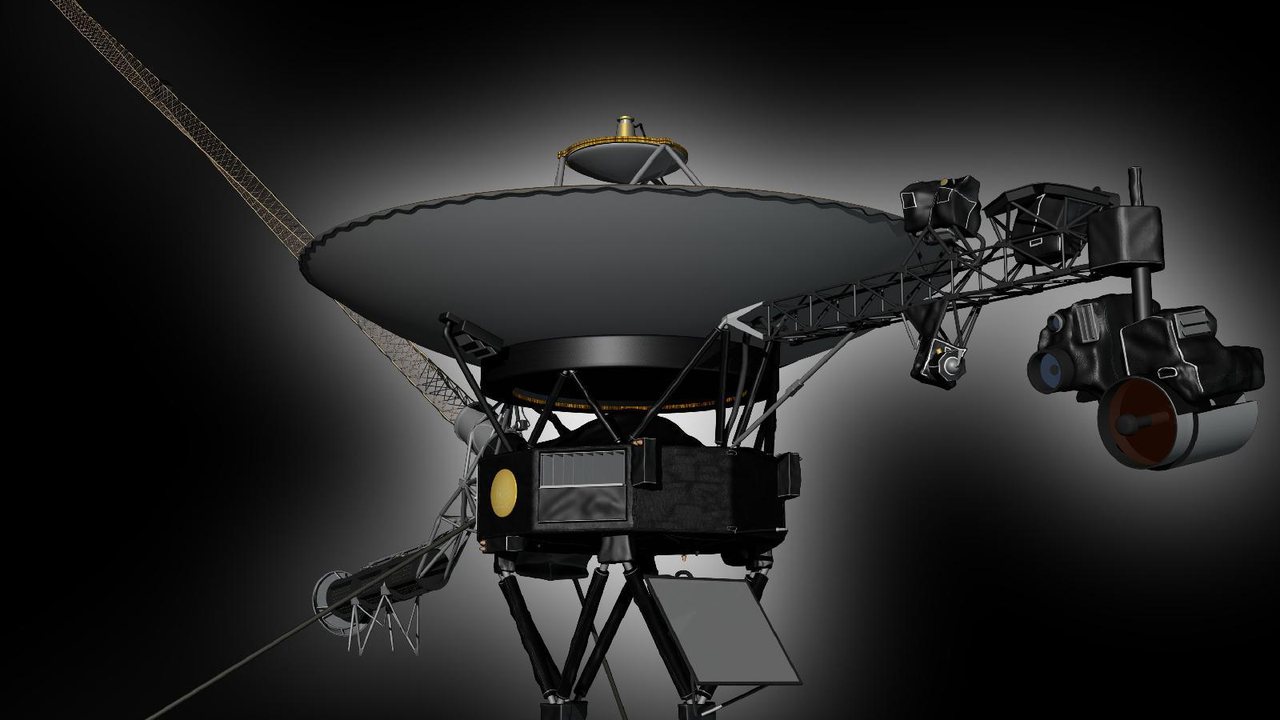
The Voyagers were built by NASA's Jet Propulsion Laboratory to take advantage of a rare lineup of the outer planets in the late 1970s, which let one spacecraft swing from planet to planet using each one's gravity. Each probe carries a 3.7-meter (12-foot) dish antenna, a nuclear power source and, at launch, ten science instruments.
Nearly half a century later they are the most distant human-made objects, and the only spacecraft to sample interstellar space directly. This page follows them from the launch pad to where they are now.
Voyager 1 and 2 at a glance
- Launches
- Voyager 2: August 20, 1977; Voyager 1: September 5, 1977
- Rocket
- Titan IIIE with a Centaur upper stage, Launch Complex 41, Cape Canaveral
- Spacecraft mass
- about 722 kg (1,592 lb) each at launch
- Power
- Radioisotope thermoelectric generators; both lose about 4 watts a year
- Planets visited
- Voyager 1: Jupiter, Saturn. Voyager 2: Jupiter, Saturn, Uranus, Neptune
- Entered interstellar space
- Voyager 1: August 2012; Voyager 2: November 2018
- Signal time to Voyager 1
- about 23 hours one way (2026)
Launch: two Titan IIIE-Centaurs from Cape Canaveral in 1977
Both Voyagers left Earth from Launch Complex 41 at Cape Canaveral on Titan IIIE rockets topped with a Centaur upper stage, the most powerful U.S. launcher of the time. The Titan IIIE flew only seven times, and its last two flights were the Voyagers.
Voyager 2 launched first, on August 20, 1977. Voyager 1 followed on September 5, 1977, but on a shorter, faster path, so it overtook its twin before reaching Jupiter. That is why the probe numbered 1 is the one that launched second.
Centaur still flies: an updated version, Centaur V, is the upper stage of ULA's Vulcan rocket, which launches from the same pad, SLC-41.
The Grand Tour: Jupiter, Saturn, Uranus, Neptune
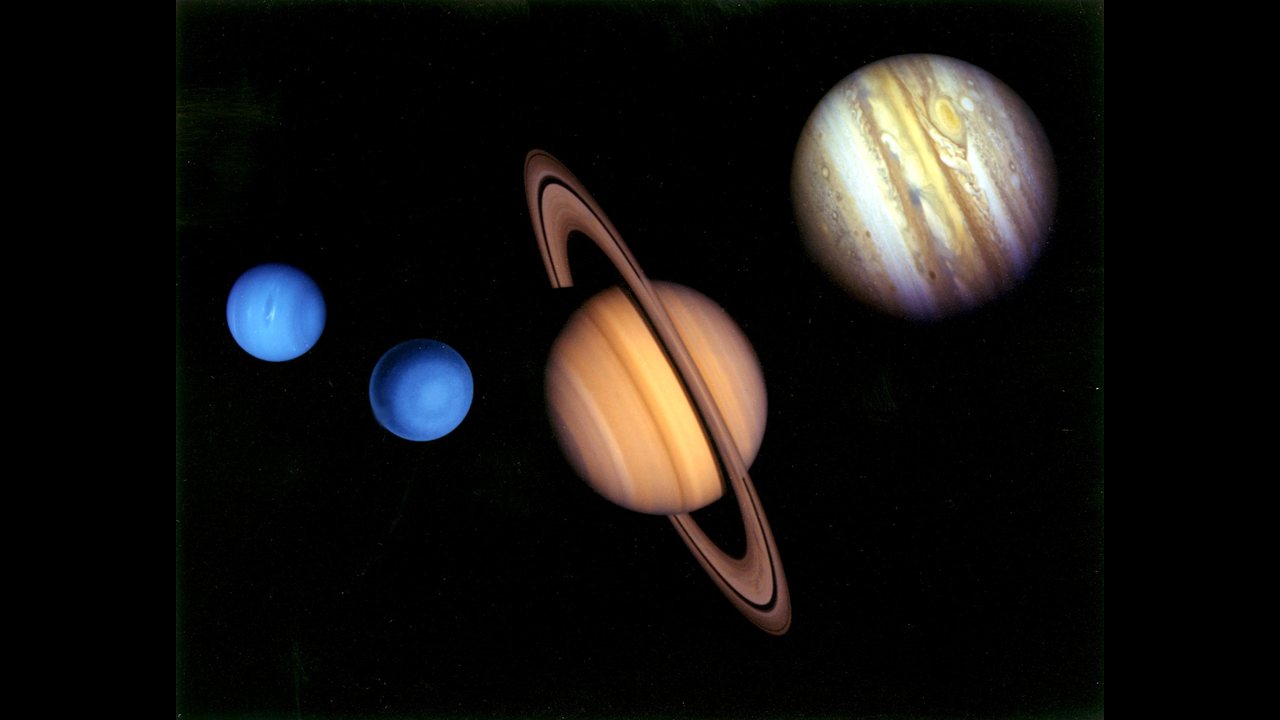
| Encounter | Closest approach | Probe |
|---|---|---|
| Jupiter | March 5, 1979 | Voyager 1 |
| Jupiter | July 9, 1979 | Voyager 2 |
| Saturn | November 12, 1980 | Voyager 1 (with a close pass of Titan) |
| Saturn | August 25, 1981 | Voyager 2 |
| Uranus | January 24, 1986 | Voyager 2 (first and only visit) |
| Neptune | August 25, 1989 | Voyager 2 (first and only visit) |
Voyager 2 is still the only spacecraft to have visited Uranus and Neptune. Voyager 1's close look at Saturn's moon Titan bent its path up and out of the plane of the planets, so it could not continue to Uranus.
Jupiter's Great Red Spot, up close
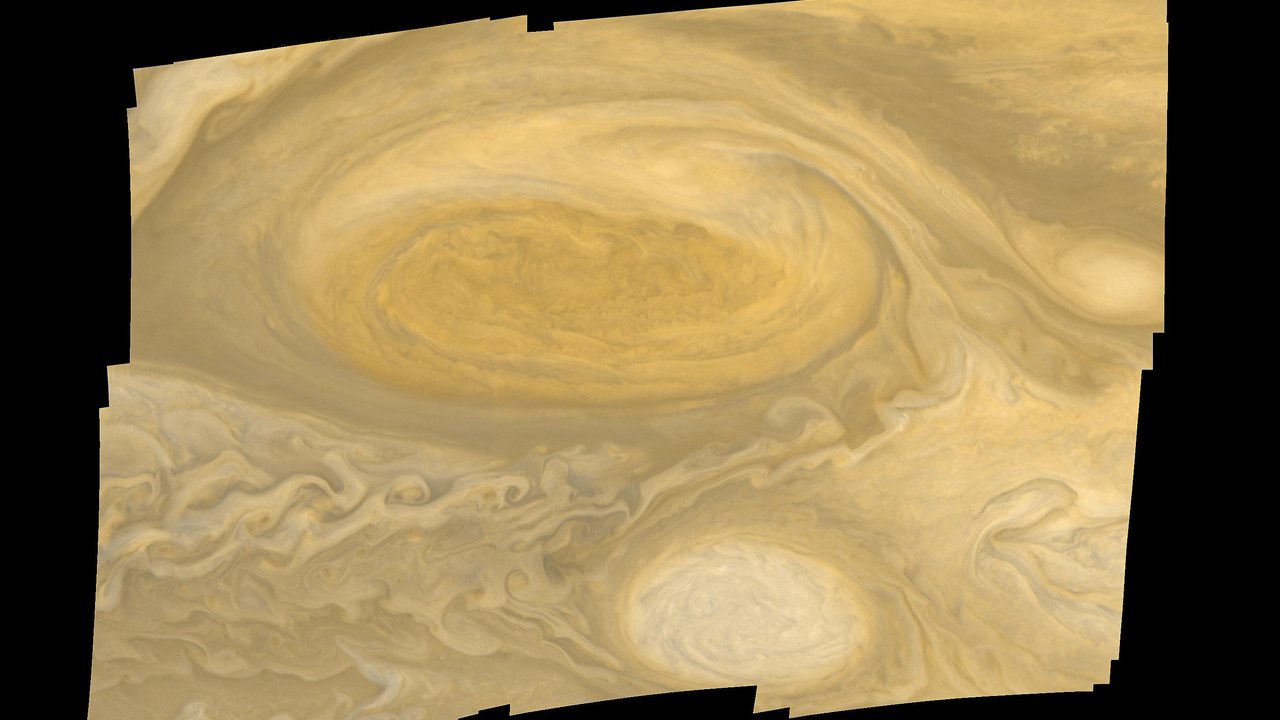
Voyager 1 took this view of the Great Red Spot in early March 1979. At Jupiter the Voyagers also found active volcanoes on the moon Io and thin rings around the planet.
The Pale Blue Dot
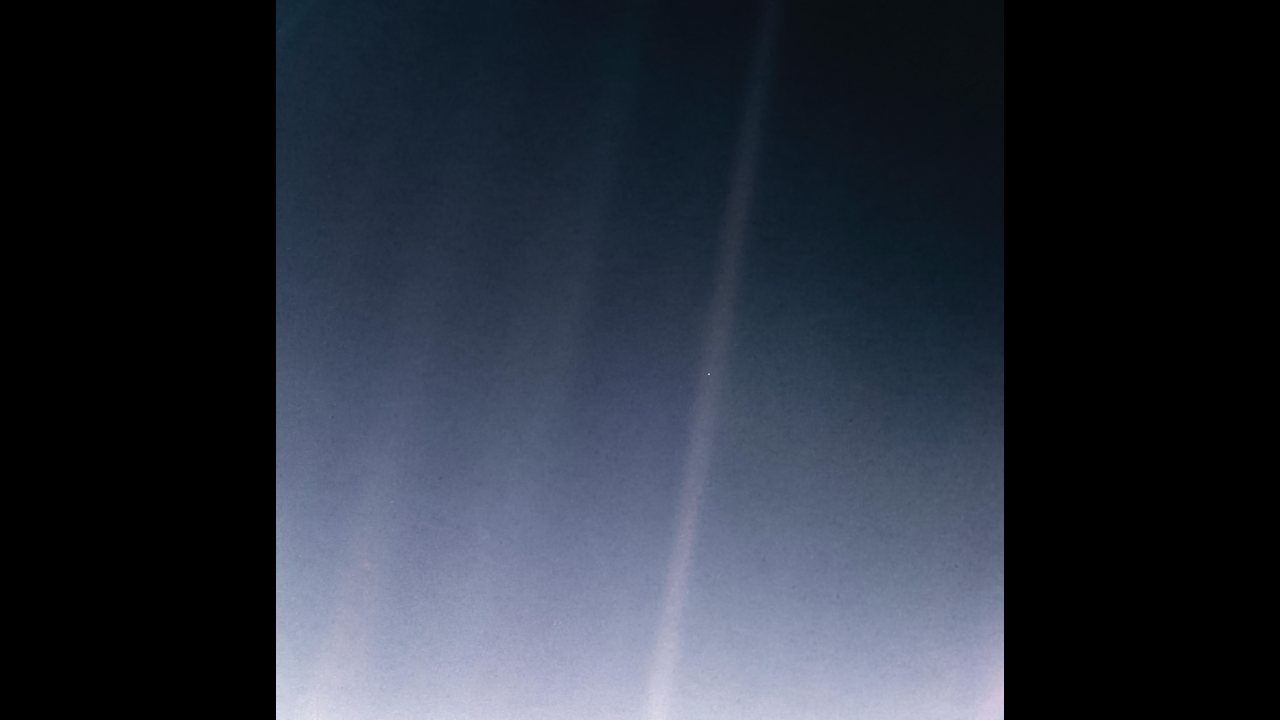
On February 14, 1990, at Carl Sagan's urging, Voyager 1 turned its cameras back toward the Sun and took a 'family portrait' of the solar system. In one frame, from about 6 billion kilometers (3.7 billion miles) away, Earth is less than a pixel inside a ray of scattered sunlight.
Minutes later the cameras were switched off for good to save power. The image above is NASA's 2020 reprocessed version, Pale Blue Dot Revisited.
The Golden Record
Each Voyager carries a 12-inch gold-plated copper record, a message from Earth for anyone who might find it. A committee chaired by Carl Sagan chose 115 images, greetings in 55 languages, natural sounds such as wind, surf and birds, and about 90 minutes of music from many cultures. The cover shows how to play it and where Earth is, using a map of pulsars.
Into interstellar space
The Sun blows a bubble of charged particles called the heliosphere. Voyager 1 crossed its edge, the heliopause, on August 25, 2012, the first human-made object to do so. Voyager 2 followed on November 5, 2018. Their instruments measure the magnetic field and plasma of interstellar space directly, something no other spacecraft has done.
Where are Voyager 1 and 2 now?
Both probes move away from the Sun at roughly 15 to 17 kilometers per second, so their distance changes every second. NASA keeps a live counter on its 'Where are Voyager 1 and 2 now?' page, linked in the sources below.
As of 2026, Voyager 1 is more than 25 billion kilometers (15 billion miles) from Earth, the farthest spacecraft ever, and a radio signal takes about 23 hours to reach it. Voyager 2 is closer but still more than 20 billion kilometers (13 billion miles) away. Voyager 1 is expected to be one light-day from Earth in late 2026.
Still working? Power, instruments, and the end of the mission
Each Voyager launched with ten science instruments. To stretch their shrinking nuclear power, the team has switched instruments off one by one in a pre-agreed order. Per NASA's status table (updated April 2026), Voyager 1 still runs its magnetometer and plasma wave instrument, after its Low-Energy Charged Particles instrument was turned off on April 17, 2026. Voyager 2 still runs its magnetometer, plasma wave and cosmic ray instruments.
In 2026 engineers completed a power-saving swap nicknamed the 'Big Bang' on both probes, replacing heater-related devices with lower-power alternatives; Voyager 1's was done in early September. NASA says this lets the remaining instruments run longer than expected. NASA has not set an end date; both probes are expected to fall silent sometime in the 2030s as power runs out.
The mission's 50th anniversaries fall on August 20 and September 5, 2027.
FAQ
Where is Voyager 1 right now?
In interstellar space, more than 25 billion kilometers (15 billion miles) from Earth as of 2026, and getting farther every second. NASA's 'Where are Voyager 1 and 2 now?' page shows the live distance.
Is Voyager 1 still sending data?
Yes. As of late 2026 Voyager 1 still returns data from its magnetometer and plasma wave instrument. Other instruments have been turned off to save power, most recently the Low-Energy Charged Particles instrument on April 17, 2026.
Which Voyager is farther?
Voyager 1. It launched about two weeks after Voyager 2 but on a faster path, and it is the most distant spacecraft ever built.
What rocket launched Voyager?
A Titan IIIE with a Centaur upper stage, from Launch Complex 41 at Cape Canaveral, Florida. Both Voyagers flew on this rocket in 1977.
Why did Voyager 2 launch before Voyager 1?
The probes were numbered by when they would reach Jupiter, not by launch date. Voyager 1 launched second, on September 5, 1977, on a shorter and faster trajectory, so it arrived at Jupiter and Saturn first.
What is on the Golden Record?
115 images, spoken greetings in 55 languages, sounds of Earth such as wind, rain and animals, and about 90 minutes of music from around the world, plus instructions for playing it.
How long does a signal take to reach Voyager 1?
About 23 hours one way in 2026, so a command and its reply take nearly two days.
When will Voyager stop working?
NASA has not set a date. Both probes lose about 4 watts of power a year, and the team expects them to go silent sometime in the 2030s after the last instruments are switched off.
Keep exploring
Sources
- NASA: Where are Voyager 1 and 2 now? (live distance)
- NASA JPL: Voyager 1 instrument shutoff, April 17, 2026
- NASA JPL: Voyager 1 conserves power ('Big Bang'), 2026
- NASA: Voyager mission
- Grokipedia: Voyager program
Images: NASA/JPL-Caltech and NASA/JPL, used under NASA's media usage guidelines. T-ZERO is not affiliated with or endorsed by NASA. Our videos: @t0rockets.