Saturn V tribute (1967–1973)
Saturn V explained

Saturn V in 56 seconds (Short)

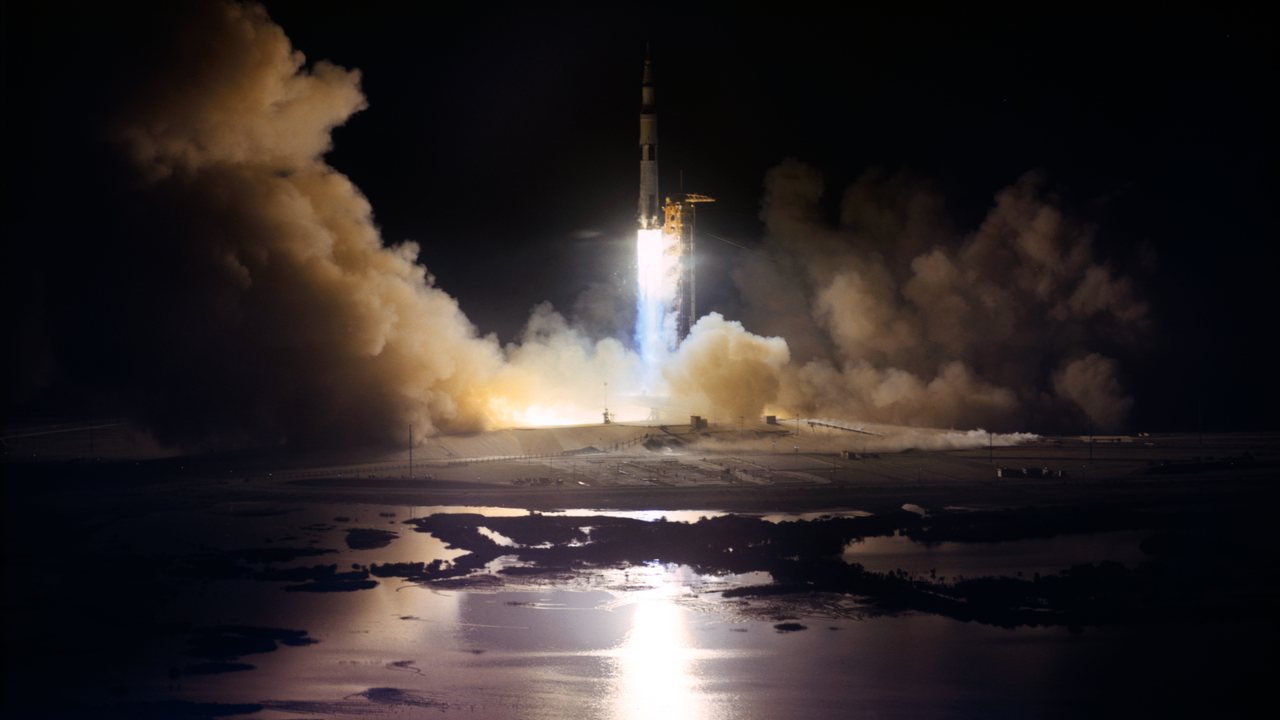
On November 9, 1967, the first Saturn V lifted off from Kennedy Space Center on the uncrewed Apollo 4 test. Built by NASA's Marshall Space Flight Center under Wernher von Braun, it stood 363 feet tall and its five F-1 engines made about 7.6 million pounds of thrust. It is still the only rocket that has carried people beyond low Earth orbit.
Saturn V flew 13 times, all from Launch Complex 39 at Kennedy, and every launch reached space. Apollo 8 sent the first crew around the Moon in December 1968, and Apollo 11 put Neil Armstrong and Buzz Aldrin on the surface on July 20, 1969. Nine crews and 24 astronauts went to the Moon; twelve walked on it. The last Saturn V launched the Skylab space station on May 14, 1973. Nothing was reused: every stage was expended.
Saturn V at a glance
- Launches
- 13 (1967–1973), all reached space
- First flight
- Apollo 4, November 9, 1967 (uncrewed)
- First crew
- Apollo 8, December 21, 1968
- Last flight
- Skylab 1, May 14, 1973
- Height
- 363 ft (111 m)
- Liftoff weight
- about 6.2 million lb (2.8 million kg)
- Liftoff thrust
- about 7.6 million lb (34.5 MN), five F-1 engines
- Payload to low Earth orbit
- about 130 tons (118,000 kg)
- Payload to the Moon
- about 50 tons (43,500 kg)
- Stages
- S-IC (5 F-1), S-II (5 J-2), S-IVB (1 J-2)
- People sent to the Moon
- 24 on nine flights; 12 walked on it
Every Saturn V flight
- Apollo 4 (1967) and Apollo 6 (1968): uncrewed tests. Apollo 6 had pogo oscillations and lost two second-stage engines, and still reached orbit.
- Apollo 8 (1968): the first people to orbit the Moon.
- Apollo 9 and 10 (1969): lunar module tests in Earth orbit and in lunar orbit.
- Apollo 11 and 12 (1969): the first two Moon landings.
- Apollo 13 (1970): the rocket did its job; an oxygen tank in the service module failed on the way to the Moon and the crew came home safely.
- Apollo 14 to 17 (1971–1972): four more landings. Apollo 17 was the first night launch and the last crew to leave Earth orbit.
- Skylab 1 (1973): a two-stage Saturn V launched America's first space station.
- Apollo 18 to 20 were cancelled. Three Saturn Vs are on display today, in Houston, Huntsville and at Kennedy.
In memory
No one was lost on a Saturn V flight. Three astronauts died preparing for the Apollo program it was built for.
Apollo 1 (AS-204)
January 27, 1967During a launch rehearsal at Launch Complex 34, atop a Saturn IB, a fire broke out in the pure-oxygen cabin of the command module and the crew could not open the hatch in time. NASA redesigned the spacecraft with a quick-opening hatch and safer materials before any Apollo crew flew.
Crew: Virgil I. (Gus) Grissom, Edward H. White II, Roger B. Chaffee
Keep exploring
Sources
Photos: public domain. Our videos: @t0rockets.